Evals
PR review
The pr-review tier measures review quality. The real
pr-review workflow posts a review, and an LLM judge scores it
against a human-verified gold set → precision, recall, and
F1. It's the one tier graded by a judge — matching free-text
findings to semantic gold comments can't be done deterministically. Triage and
code-fix stay judge-free.
The gold set can come from two sources, and the tier runs the same either way:
- Your own reviewed PRs — build a dataset from real PRs your team has reviewed. This is the everyday path for tuning a deployment.
- Martian's Code Review Bench — an optional public benchmark of 50 PRs that also lets you see where a run would rank against published tools.
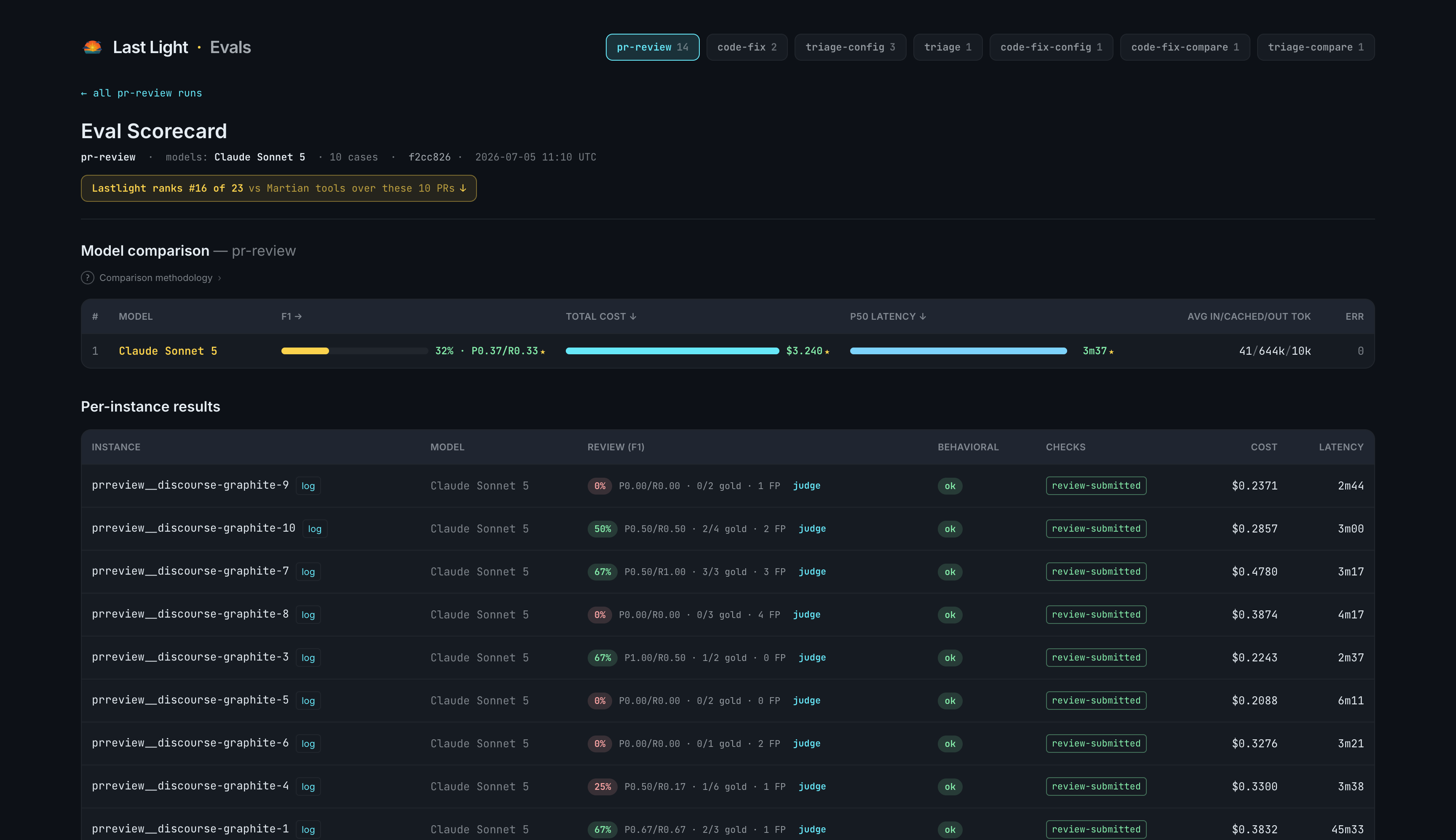
pr-review scorecard — F1 headline, per-instance precision/recall, and a judge button on every row.Option A — bring your own gold PRs
Author cases from real PRs your team has already reviewed with
add-case --pr <url> --review.
It pulls the PR fixture and a candidate review_gold from the human
review (inline comments + substantive review bodies, with bot / nit / reply /
LGTM noise filtered out) and prints an evidence block; you assign real
severities and prune non-actionable comments.
lastlight-evals add-case --pr <url> --review --dry-run   # propose; read the evidence, curate
lastlight-evals add-case --pr <url> --review             # write into ./datasets/pr-review (or --overlay)
lastlight-evals run pr-review --model <model>            # run against your dataset
Re-running a PR replaces by id, so building up a dataset one PR
at a time is safe. Cases you author are byte-compatible with Martian imports, so
the two can coexist in one instances.json. The full authoring flow —
severities, the anti-spoil guarantee, curating for many PRs at once — is on the
Authoring cases page.
Option B — benchmark against Martian's Code Review Bench
Martian's Code Review Bench
is an optional public benchmark: 50 real merged PRs (Sentry,
Grafana, Cal.com, Discourse, Keycloak), each carrying inlined
golden_comments with base/head SHAs pinned. Because they're large
real-repo PRs, the tier ships empty — you import them:
npx tsx scripts/import-martian.ts            # resolve all 50 via gh (pins base/head SHAs)
npx tsx scripts/import-martian.ts --limit 3  # a quick subset first
npx tsx scripts/import-martian.ts --dry-run  # print the first resolved instance, don't write
It needs an authenticated gh and network. Entries with no
golden_comments or an unrecognized source URL are skipped and
logged — never silently dropped. Then run the tier exactly as above:
lastlight-evals run pr-review. The payoff of using Martian's set is
the leaderboard ranking below.
How the judge grades
Whichever source the gold comes from, grading is a two-step LLM judge:
- Extract the review's distinct, concrete findings (dropping praise and summaries).
- Match each finding to a gold comment — same underlying issue?
From the matches: precision = matched ÷ posted,
recall = matched ÷ gold, combined as an
F-beta. The headline is F1 (β = 1, precision
and recall weighted equally — Martian's leaderboard metric). Pass
--f-beta 0.5 (or EVAL_F_BETA=0.5) to weight precision
2×; the dashboard relabels the column F{β} to match.
lastlight-evals run pr-review --model <model>                   # full tier
lastlight-evals run pr-review --model <model> --limit 3         # first 3 cases (controlled)
lastlight-evals run pr-review --model <model> --f-beta 0.5      # weight precision 2×
lastlight-evals run pr-review --model <model> --judge-with-diff # give the judge the diffThe judge is independent — and inspectable
The judge model is independent of the models under test (a strong default per
your provider key, overridable with EVAL_JUDGE_MODEL; one-shot,
temperature 0). A judge failure marks the case errored (ungraded),
never a silent zero. By default it's diff-blind — it reads only
the posted review, mirroring Martian's offline judge; --judge-with-diff
feeds it the PR diff for higher-fidelity matching (and marks those grades
diff-aware, trading away leaderboard parity).
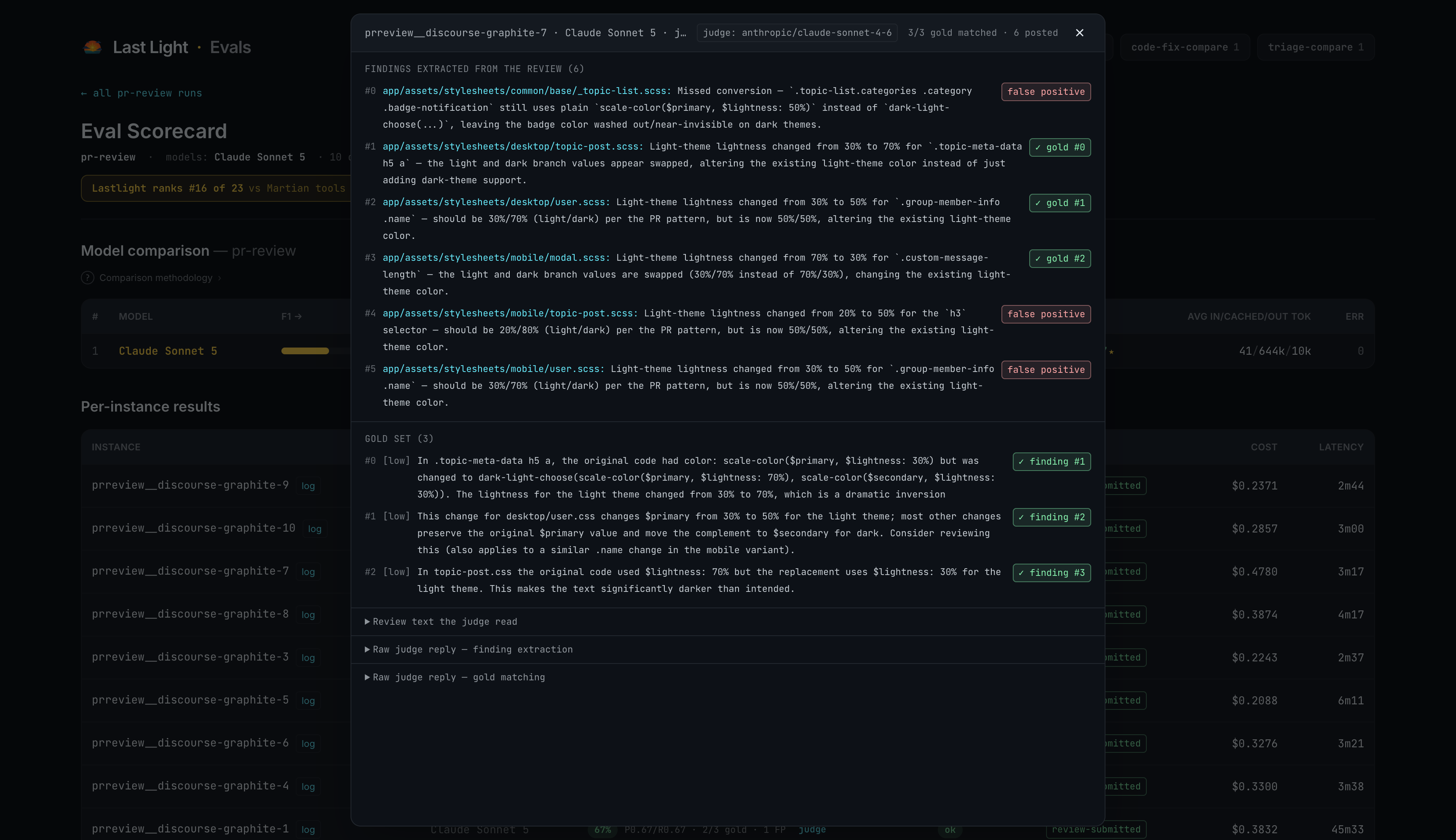
Every per-instance row has a judge button that opens the judge's full working — the findings it extracted, the gold set, and the finding ↔ gold pairing (matched / false positive / missed) — so an F1 score is never a black box:
Give the reviewer repo context
A PR is locked at its head SHA, so the reviewing agent only sees the code — not
the conventions a maintainer carries in their head. The harness can inject a
synthetic AGENTS.md / CLAUDE.md into the checkout so the
agent reads it (the coding agent auto-loads it, walking up from its working
directory — no prompt change needed). Two presence-based sources, on by default:
- Generic —
<overlay>/repo-context/AGENTS.md, injected into every reviewed repo. For guidance that helps on any codebase (e.g. "prefer concrete, line-anchored findings; suppress pure style nits"). - Per-repo —
datasets/pr-review/context/<instance_id>/AGENTS.md, injected only for that case's repo. This is the portable "add this to your repo and reviews improve" recommendation — honest because it's exactly what a maintainer could commit.
It appends to a real AGENTS.md / CLAUDE.md if the repo
ships one (never shadowing it), and records which context each case saw on the
scorecard. Toggle it off for a clean control run to measure the lift:
lastlight-evals run pr-review --overlay instance                      # inject (default)
lastlight-evals run pr-review --overlay instance --no-inject-context # control (or EVAL_INJECT_CONTEXT=0)Where would this rank? (Martian only)
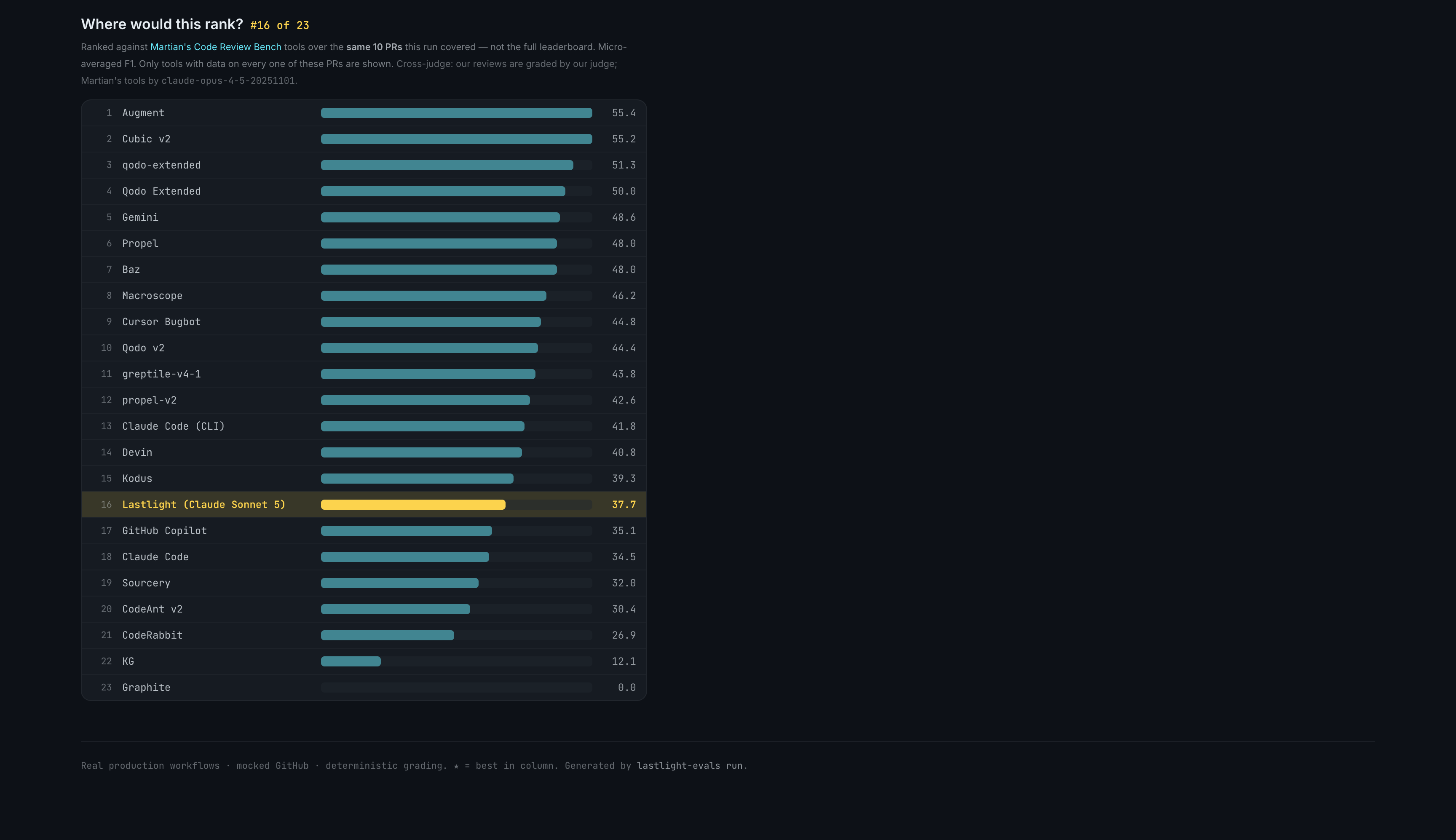
When your run covers Martian PRs, each scorecard also computes a leaderboard sidecar: where would this run place against the benchmark's tools, over the same PRs this run covered (micro-averaged F1; only tools with data on every one of those PRs are shown). It's a like-for-like slice, not the full leaderboard — and it only appears for Martian-sourced cases, since your own PRs aren't on it.