Evals
Triage
The triage tier runs the real issue-triage
workflow: the agent reads a freshly-seeded issue and decides how to triage it —
which labels to apply, whether to ask for more info, whether to close it. It's
the cheapest and fastest tier, so it's the best one for smoke-testing the
harness or a forked workflow.
lastlight-evals run triage                       # default model
lastlight-evals run triage --model haiku         # one model
lastlight-evals run triage --compare             # cross-vendor set
lastlight-evals run triage --runs 3              # repeat each case (worst-case verdict)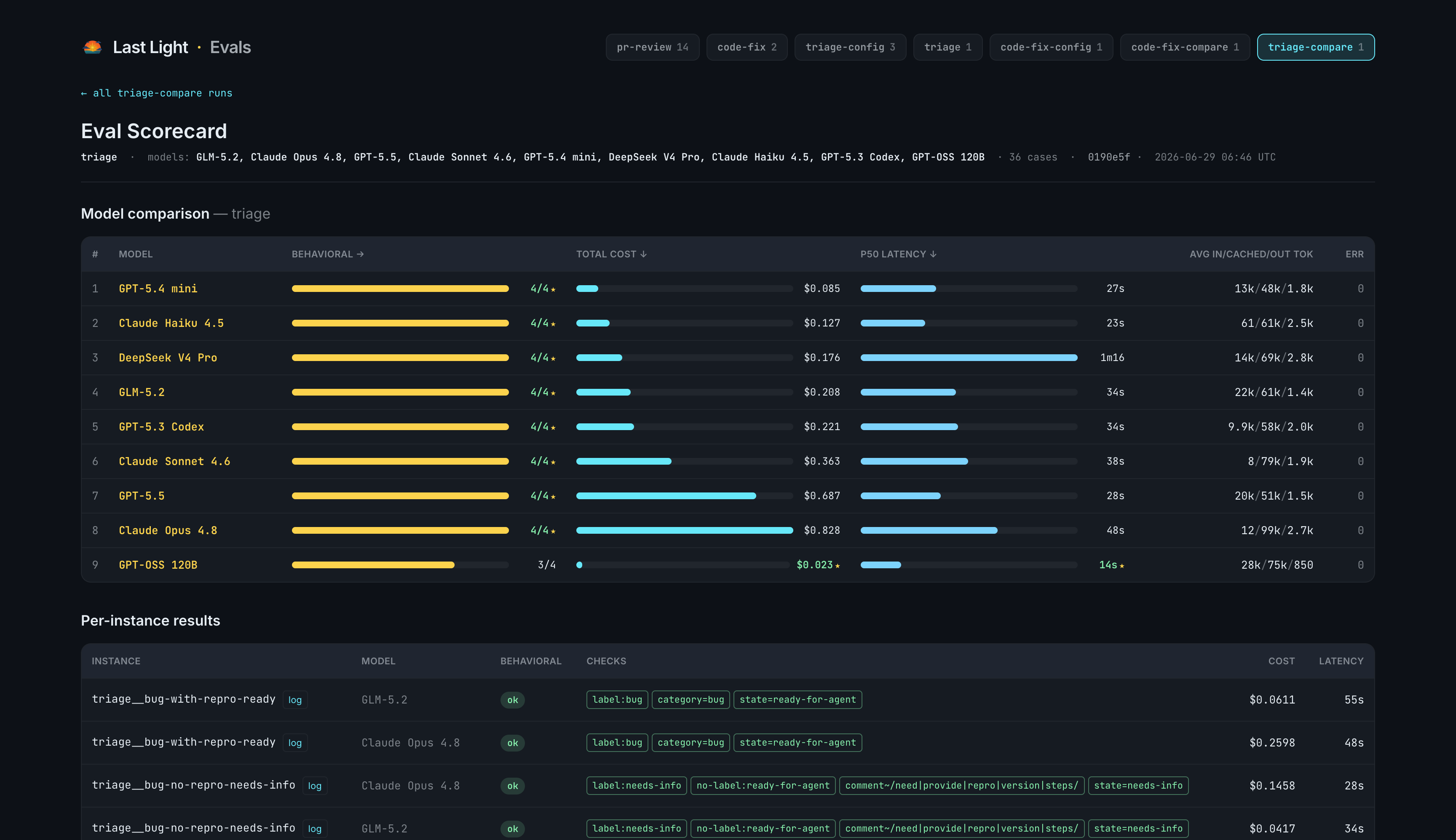
triage comparison — behavioral pass rate, and the exact label / category / state checks per case.How it's graded (behavioral)
Triage grading is behavioral: it asserts the GitHub mutations the agent actually made — recorded by the in-process fake GitHub — against the instance's expectation. A case passes only if every expected mutation happened and every forbidden one didn't:
expect_github.labels_added/labels_absent— labels the triage must (or must not) apply.expect_github.comment_matches— a regex the posted comment must match (e.g. asking for a repro).expect_github.issue_closed— whether the issue should end up closed.triage_gold— the expected{ category, state }classification per your deployment's taxonomy.
Each per-instance row in the dashboard shows exactly which checks it asserted
(label:bug, category=bug, state=ready-for-agent,
…), so a pass or fail is legible at a glance. Only the fields present on an
instance are checked, so a case can assert as much or as little as you want.
Adding a triage case
Two ways. Hand-write a SweBenchInstance in
datasets/triage/instances.json (the issue seed,
triage_gold, and expect_github), or scaffold from a
real resolved issue:
lastlight-evals add-case --issue <url> --dry-run   # propose a triage case; don't write
lastlight-evals add-case --issue <url>             # write into ./datasets/triage (or --overlay)
add-case --issue pulls the issue content and the labels that were
actually applied — read from the issue events API, so the evidence
shows who applied each (maintainer vs bot) — seeds the issue
without its triage labels so the agent triages fresh, and sets
expect_github.labels_added / issue_closed. You then
assign triage_gold per your taxonomy. The full flow is on the
Authoring cases page.